
Depending upon where you look and what you believe, life is very much as it’s ever been—or we’re on the precipice of change more profound and fundamental than anything in the past 80 years.
In terms of outlook, I tend to fall into the latter category. From geopolitics to economics to artificial intelligence, it feels as though massive waves of change are inexorably rolling our way—and the waters are already pretty choppy. For anyone like-minded this raises a rather existential question: Hold your breath and hope, or dive in and get moving?
If you’ve got a problem-solving disposition, the answer is pretty clear. Hope is a product of action: the more you do, the more progress you make, and the more hope grows. This is a necessary mindset during a time of profound change, feeling empowered is vastly superior to being helplessly swept away.
Local is where it’s at.
My own interest is local. Or perhaps better put: my interest is localities. How do the cities, towns and regions of the world harness change to their advantage? What role does innovation—the practice of engineering change to one’s advantage—play for each place? How do they make it happen? I find this endlessly fascinating. And because this is my interest, I’ve managed to interview a lot of amazing people whose careers are dedicated to making their place, from Lansing to St. John’s to Sudbury, the best possible place to live and work.
But I’ve also been researching innovation ecosystems, how they behave, and the economic models that affect them. They’re best thought of as complex adaptive systems, ever-evolving based upon their own unique set of geographic, social and economic circumstances. And while no one directly manages an innovation ecosystem or local economy, how well they perform can be observed, measured and influenced. The most important concept is economic complexity, with research pioneered by Harvard’s Ricardo Hausmann. A place is economically “complex” when it can make and export a wide variety of sophisticated, hard-to-copy products that few other places manage to produce. This creates local advantages, making it more economically resilient and more adaptable to change.
With the inclusion of a strategy framework, interviewing local innovation leaders via an economic complexity lens creates a productive interview format. My questions are straightforward but always situated within this methodology, producing insightful answers to the complex challenges of local innovation and economic development.
Speaking of complexity…
And then a truly massive wave of change hit, this one more with far more personal impact than anything in years. They call it, with amusement and memes, vibe coding. But that term is entirely, profoundly misleading. At Anthropic, home to mind-bendingly powerful AI like Claude Opus 4.6, software engineers have stopped coding. They prompt. They guide. They check. They interact with the AI. And then they push out the code to people like you and me.
For me, tools like these are life changing, no exaggeration. From the business side, I’ve got a strong product background. In the past, partnered with extremely talented developers, I’ve built some pretty awesome software—stuff I remain proud of. But my critical weakness was life altering: not a coder.
But now? The door hasn’t just been kicked down, it’s been vaporized. I’ve got the product background. I’ve got a specific base of knowledge in a specific area, and a unique framework to help make sense of it. So, a couple of months ago in mid-December, I started, beginning from—with no exaggeration—a complete, total, and absolute lack of understanding of how to build a fully functional application.
Making software, one eye-rolling mistake at a time
Around mid-December I was prototyping on Google AI Studio. A week later I was on Firebase Studio. I was such a novice that it confused the hell out of me when everything needed to be backed up on GitHub. By early January, something odd was happening: the needs of my product were outstripping the Firebase AI’s capability to deliver. It made errors, lots of them. Obviously Mr. Vibe Code over here was the author of his own demise on many occasions but the overall pattern was clear: individual AI’s have a ceiling and I’d gone a distance beyond Firebase’s.
I’d noticed that GitHub has its own IDE (integrated development platform) but was pretty wedded to Firebase so it was really only by necessity that I took a deeper look at GitHub’s AI development tools. GitHub’s IDE has lots of AIs to choose from, not just one. I chose Claude Opus 4.5 (now 4.6) and redoubled my efforts.
Hello, Ecosystem Navigator!
This was the moment the game changed again. Suddenly, the thing I really wanted to deliver—a genuinely helpful, hyper-local innovation ecosystem diagnostic using my virtuous innovation cycle framework—was entirely within reach. Plus account management, Stripe integration, Serper integration, data management for comps and the myriad tiny things without which success is inconceivable.
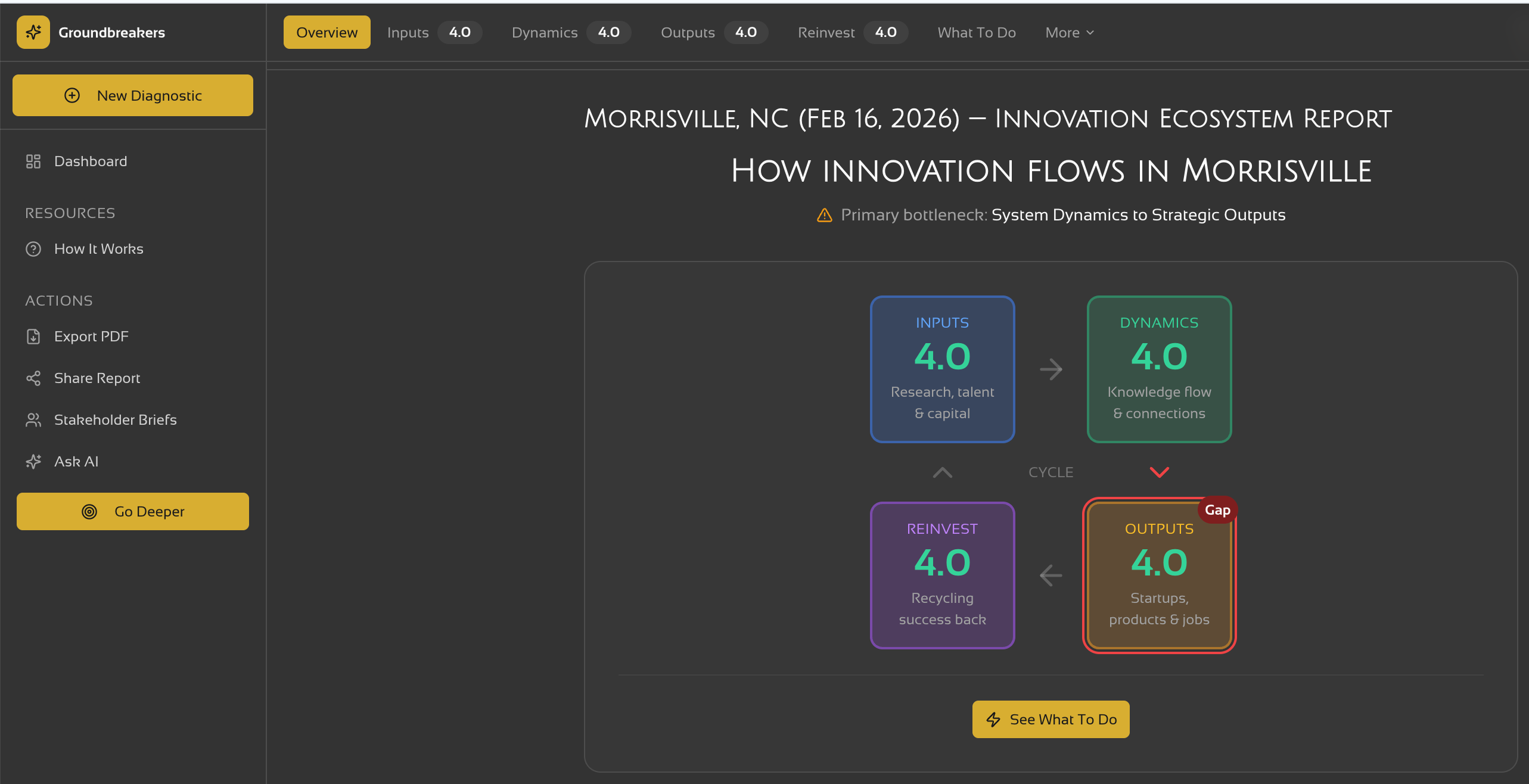
The result is two things. The first is the classic minimum viable product (MVP) with endless possibilities for growth and improvement. So new that branding and naming isn’t yet settled—I’ve barely placed The Groundbreakers brand in there. The second? It’s really good! It’s by no means perfect, and the grind of bug fixing and improvements big and small is daily, but it’s good. The framework is excellent; the AI does the heavy-lifting.
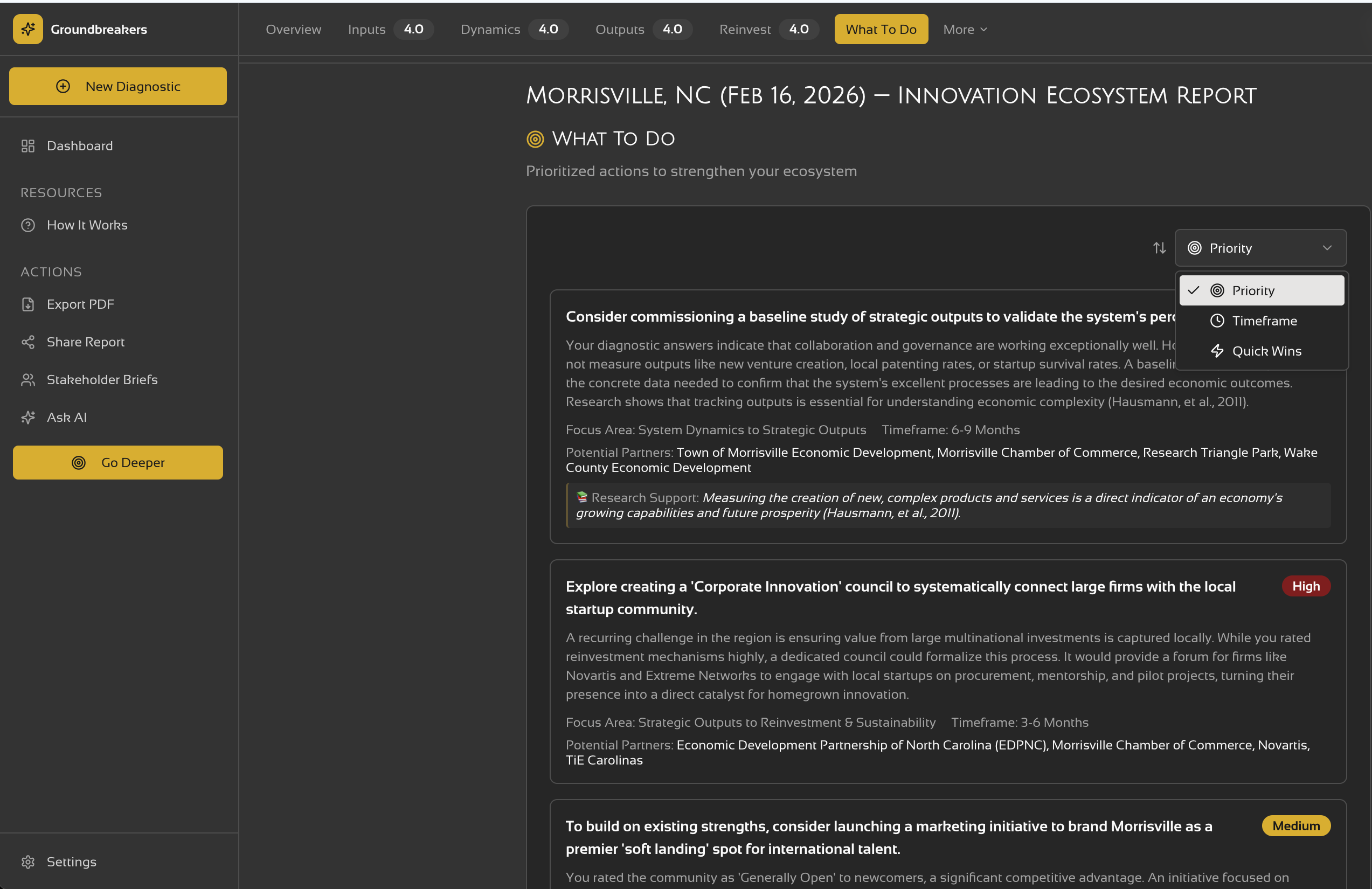
The thing I envisioned, a quick, practical tool economic development and innovation professionals will regularly use to get a quick gauge on where they stand, to compare with other places, to convey results to partners and other parts of government, has come to life in 1.0 form.
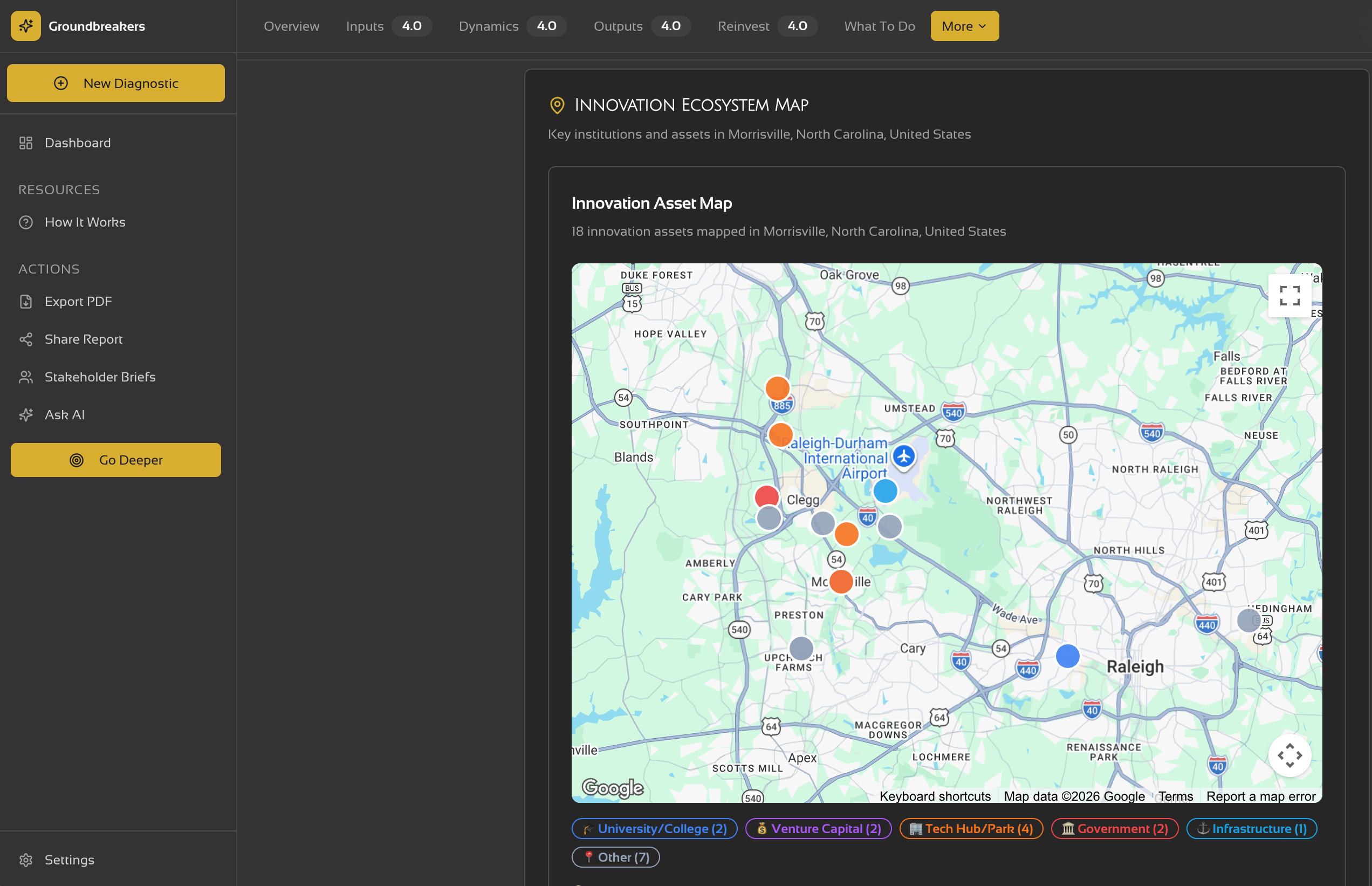
Change is coming. Managed correctly, bent to our advantage, that’s a good thing. Every place, everywhere, has the tools and local advantages to start. We have new ways to approach old problems. We take a step, we make progress, and a virtuous innovation cycle springs into life.
Notes
As part of soft launching the product, over the past week I reached out to about 40 people, literally from around the planet, asking them to have a look. My thanks to them for their interest and feedback!
Feel like helping? If you’re from an economic development background—or know someone who is—then please feel free to reach me! Simply reply to this email.
Yes, video interviewing will continue. I had to pause and build the app, it was an overriding imperative. So, I’ve got more video interviews to publish in the coming weeks and months.
On that score, I realized that I was overdoing the onscreen text. When the next wave of video interviews are published, they’ll be simpler. My hope and intention remains finding ways of extracting the maximum value from the important things each interviewee says… too much text wasn’t the way.