
(Ian — Amazing what adding a member to your team can do: more stuff, more quickly! Better quality. With a producer and marketer on board, we should see an significant uptick in productivity: I can reopen the video interviewing side of The Groundbreakers, here on Substack, while focusing even more time on developing the Ecosystem Navigator, the app inspired by writing about innovation ecosystems and interviewing local economic development leaders.)
~
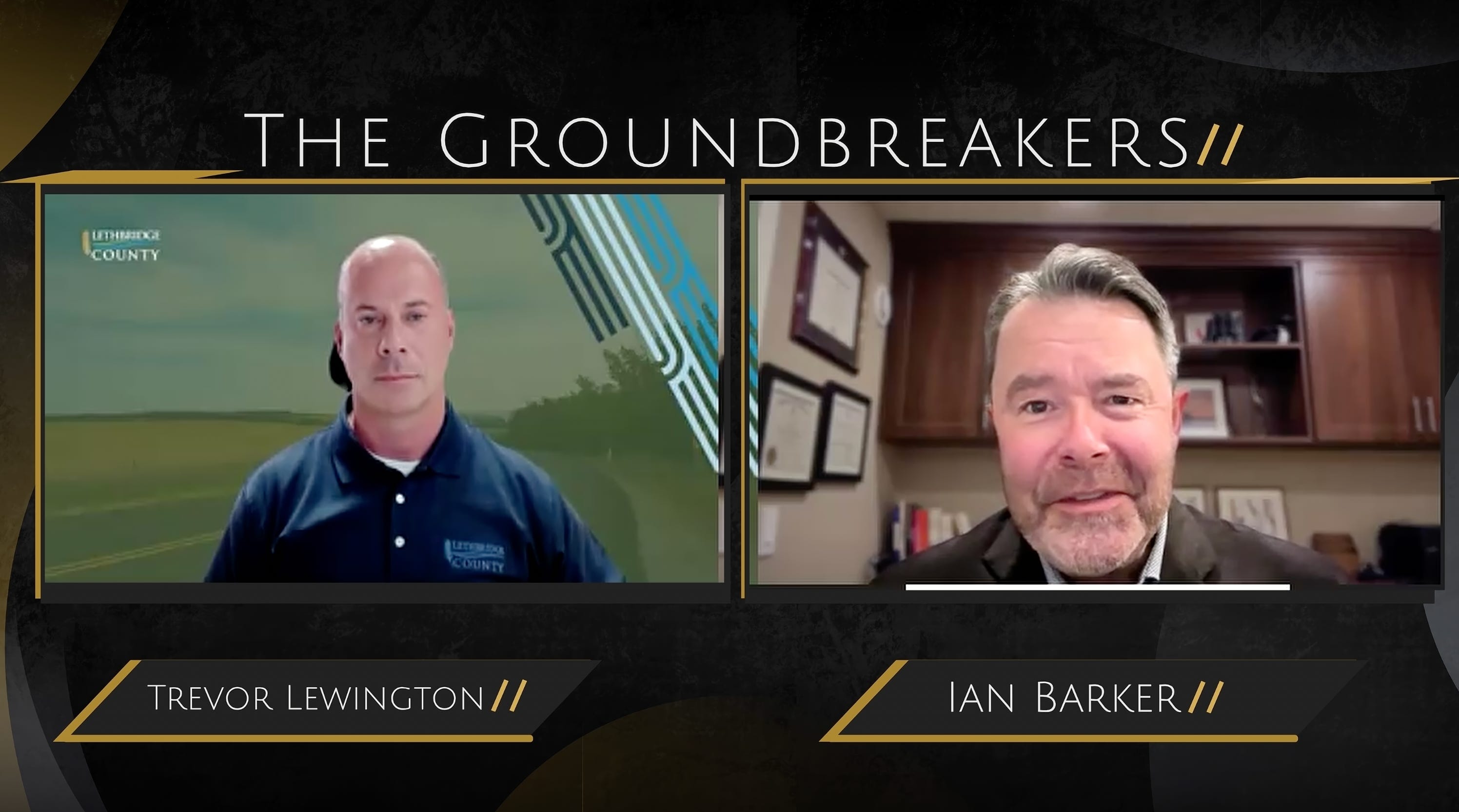
On September 18th, Lethbridge County, Alberta, and The Groundbreakers, based in Toronto, hosted a virtual media scrum. Portions of the event have already been posted to my Substack, and we received superb television coverage from CTV, Global, and Bridge City News. What’s been missing is edited coverage of the full event.
If you are in economic development, government, business, or academia you’ll find this short video useful. Creating the conditions necessary for economic growth, innovation and resilience is immensely important and, frankly, there’s no time to wait. With all that’s happening — tariffs, new trade alliances, AI transformation — none of us can afford to wait months to get the data needed to act, or pay heavily for that information when those resources can be dedicated much more productively to actually getting things done.
We can do a diagnostic now with a group of stakeholders, follow the recommendations, and then a year from now run that diagnostic again to track changes over time. It’s quite powerful to have a measurable way of understanding the impacts we can have and how we actually drive economic development forward.”
— Trevor Lewington, Director of Growth & Engagement, Lethbridge County
Video Chapter Index
00:05 – 01:47 | The Municipal Challenge: Trevor Lewington introduces Lethbridge County’s economic development goals and the rural-urban ecosystem divide.
01:47 – 05:48 | Platform Demo: Ian Barker outlines the mission behind The Groundbreakers and demonstrates the Ecosystem Navigator’s heat maps and reporting engine.
05:48 – 06:48 | Origin Story: How a Substack focused on peripheral innovation evolved into an end-to-end SaaS diagnostic tool.
06:48 – 08:11 | Why Lethbridge County Partnered: Replacing six-figure legacy reports with real-time feedback loops.
08:11 – 09:48 | AI in Economic Development: Distinguishing generic LLM content from human-powered local data processing.
09:48 – 11:17 | The Regional Ecosystem Vision: Viewing polytechnics, Indigenous groups, and neighbouring towns as an interconnected regional network.
Full Transcript
[01:00:00:05 - 01:01:47:19]
Trevor Lewington, Director, Growth & Engagement, Lethbridge County
Okay, well good morning everyone and thank you for joining us this morning for this scrum. Appreciate everyone’s time. We know you’re all busy. I think you all know me, but Trevor Lewington, Director of Growth and Engagement with Lethbridge County. And so I think all of you are familiar, you know, I’ve certainly talked to you all before, I think about the rich innovation ecosystem that we have here in southern Alberta. But where it can be a challenge for a municipality like Lethbridge County is how some of those things come together and how they fit with some of the urban areas that are within the county, some of our hamlets within the county, and frankly how rural residents, rural Albertans, can connect with those resources that are often based in an urban center. So part of the work we were doing was trying to better understand the ecosystem that lives in and around Lethbridge County, find ways that we could map that, measure that, track that, and really have a deeper understanding of how it fits together. So enter Ian Barker and his the work he’s doing with the Groundbreakers ecosystem navigator, which is a unique platform that allows me to gather intelligence and insight from stakeholders inside and impacted around the county and really get some concrete recommendations, some concrete learnings about how to best support those business stakeholders. I think it gives the county a way to measure effectiveness over time. Ian will talk about that, but you know, we can do a diagnostic now with a group of stakeholders. We can take action, we can follow the recommendations that are created in the tools report, and then a year from now I can run that diagnostic again and track changes over time. And so I do think that’s quite powerful to have a measurable way of understanding the impacts we can have and how we actually drive economic development forward. So with that, I’ll hand it over to Ian to give you an overview of who he is, what the ecosystem navigator tool is, and give you a quick demo. And then again, we’ll answer your questions.
No ChatGPT insights are going to be as powerful and precise as insights people can provide based on their experience. But what AI can do in this case is bring that together, shed a light on it, and organize it in a way that I might not be able to do myself.”
— Trevor Lewington, Director of Growth & Engagement, Lethbridge County
[01:01:47:19 - 01:05:48:14]
Ian Barker, Editor & Founder, The Groundbreakers
My name is Ian Barker. I’m the editor and founder of the Groundbreakers. The context for the Groundbreakers is pretty straightforward. We’re all aware of the effects of tariffs, the effects of trade and new trade alliances. We’re aware of the effect of artificial intelligence and how everything is transforming. And there’s this genuine question of how do the non-Silicon Valley places of the world actually respond to these really challenging times and challenging circumstances. And the answer to this is always, well, give me more information and then organize this information in a way in which I can actually have an impact and have a chance to make a difference.
That is the technology that I actually developed, which is called the Ecosystem Navigator. The concept here is to ask structured questions around strategy and around economics of people who know a local region and then find a way of generating a report that allows us to conduct some in-depth analysis. And again, let’s just make one thing clear here that when we ask structured, strategic and economic questions of people who know an area, what we end up getting is insight from those experts that we couldn’t otherwise get. To actually get this information in a structured way is incredibly useful because it directs our time.
And what we found from talking to Trevor and to others who’ve used the platform is that this process, which on the surface looks relatively simple, actually yields a tremendous benefit. What I’m actually getting is very targeted, very direct feedback about areas and opportunities that I can take advantage of. In the case of the work that we’ve done with Lethbridge County, we’ve uncovered a number of clear areas of opportunity. This is not to say that they weren’t the things that would be on the radar already. This is not something in which we’re reinventing the wheel or what have you. What this is doing, however, is saying, all right, now, if we ask all the experts in the area the same questions and we ask very pertinent questions around strategy and around economics, we’re going to get very directed, very organized feedback that we can make tremendous use from. And months, frankly, can be taken off the schedule here. So the key here is that I have the chance to save myself tremendous time by getting great information from people who know a region.
I don’t want to talk to Toronto, and I don’t want to talk to Boston, and I don’t want to talk to Silicon Valley. I want to talk to my market... local places that are aggressively pursuing change.
Ian Barker, Editor & Founder, The Groundbreakers
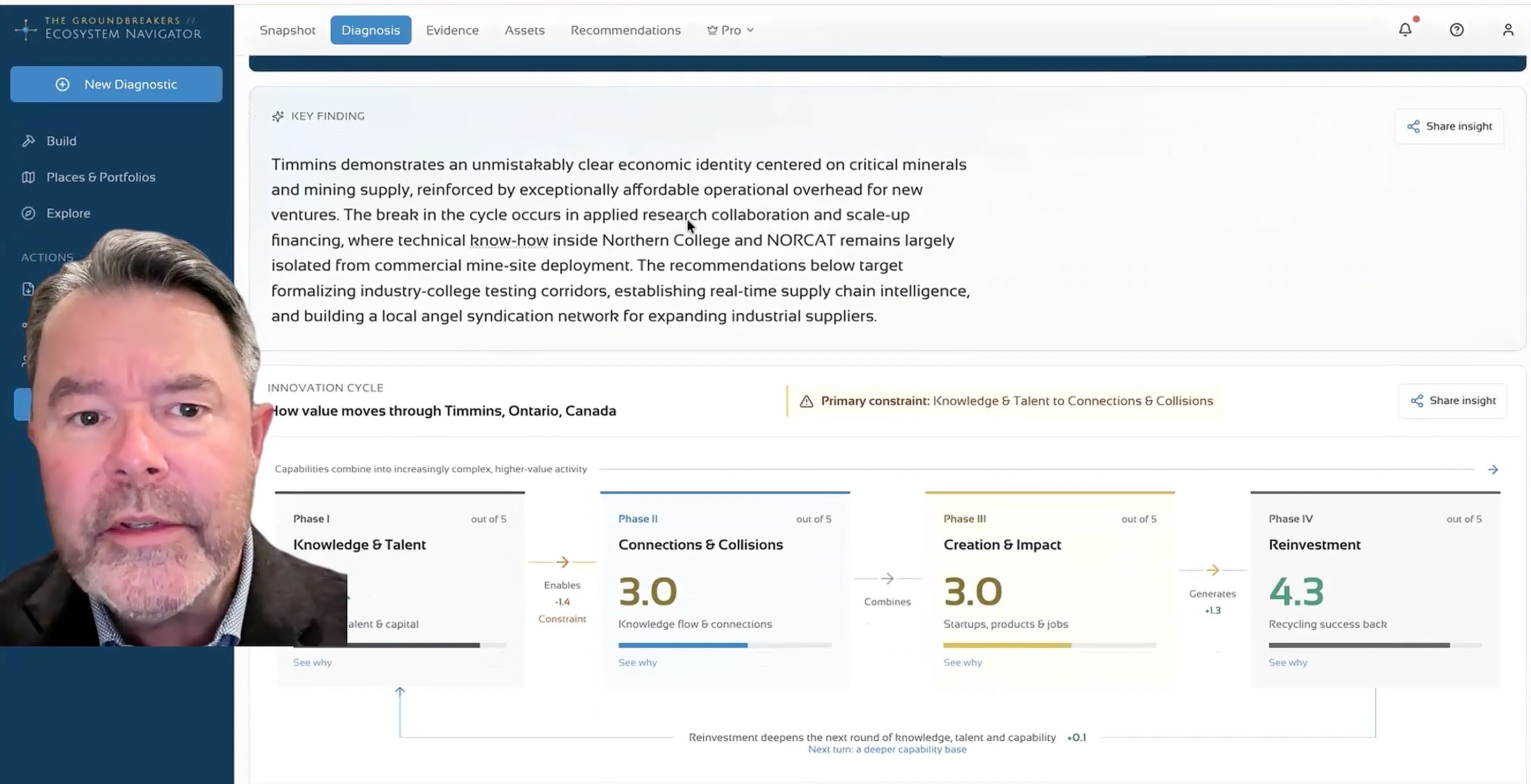
What we’re looking at here in this particular slide is the aggregated feedback from a different place, not Lethbridge County, for the purposes of showing you how some of the results of the platform can generate. We’ve organized it at what I would call a virtuous innovation cycle, which is simply an easy way of thinking about how do I organize the feedback that I’ve gotten in such a way that I can visualize the movement of knowledge, of talent, and of capital within an area with an eye to making it more effective. Here, we can see here in what I call, it’s just a simple heat map, is variance. I asked the same question of different places within the same region, and I see differences here. And I can act on that variance by picking up the phone and organizing a meeting. I can find different ways that I can go about doing it. In the online product, when I do this, and actually give them the very specific set of recommendations themselves, so I actually have something immediate and tangible to act upon. Now, I wanted to show you what a sample report looks like, because everybody’s given the same types of questions. There are 15 questions covering five strategic categories, and then organized in this virtuous innovation cycle concept. So an example here, I’ve done myself for for Timmons. And when I’m going through the questions, it produces in moments, a report that I can actually act upon. It organizes information, as you can see here, in what I’ve called the virtuous innovation cycle, which is again, simply the movement of knowledge, capital and talent within a given region, and then spits out a series of recommendations here that I can actually begin to act on. And what’s cool about this, and one of the things that I’m actually very, very excited by, is when we organize this and put out a group diagnostic, asking the same questions of people within a region, and I start getting those responses in, it happens in real time, and I can actually begin to act very quickly. So months can be taken off the planning schedule, I can direct my resources towards what needs to get done, as opposed to supposing or hoping. I hope I’ve covered the landscape relatively well there. If anybody’s got any questions, I’m quite happy to take them.
Tools like this democratize access to information. Typically, this would be a large consulting report. You’d pay tens of thousands, if not hundreds of thousands of dollars to reach conclusions that this software can give me much faster... No one knows your market better than the people living and working and operating businesses in it.”
— Trevor Lewington, Director of Growth & Engagement, Lethbridge County
[01:05:48:14 - 01:05:54:19]
Media Member
My question really is just how this sort of came to be, and when did this actually first start?
[01:05:54:19 - 01:06:48:15]
Ian Barker, Editor & Founder, The Groundbreakers
I would say early spring is when Trevor and I first began chatting about this. I have been running The Groundbreakers now for a few years, but I started it as purely as a Substack, talking to local innovation experts. I’m really interested, right? How do the non-Silicon Valley places of the world respond in a world of tremendous change when it really looks like all the capital and all the talent is flowing down to Silicon Valley and other large centers? Well, what is the response? And then the reality is that every single place is unique and actually does have things that it can do. Around December of last year, I realized that I might be better utilized myself, actually developing my own platform. And this is now an end-to-end SaaS that covers how to build a diagnostic, the diagnostic itself, the reports, group reports, full analytics, e-commerce platform, sharing content, the whole bit from soup to nuts is in there now.
[01:06:48:15 - 01:06:54:03]
Media Member
Why was Lethbridge County kind of the right partner, right time kind of situation?
[01:06:54:03 - 01:07:15:13]
Speaker 2
From my perspective, I don’t want to talk to Toronto, and I don’t want to talk to Boston, and I don’t want to talk to Silicon Valley. I want to talk to my market. My market is the Valley places of the world. I’m looking for places that are aggressively pursuing change, that want to make circumstances better for their constituents. And so that was the genesis of reaching out to Trevor.
[01:07:15:13 - 01:07:21:12]
Media Member
Maybe Trevor, just for you as well, just what maybe benefits have we seen since the spring with this partnership?
[01:07:21:12 - 01:08:11:10]
Trevor Lewington, Director, Growth & Engagement, Lethbridge County
Yeah, many. So I mean, the tools like this give sort of democratize access to information. So typically, this would be a large consulting report. You’d pay tens of thousands, if not hundreds of thousands of dollars to reach conclusions that this software can give me much faster and powered by, as Ian said, feedback from people locally that are completing the survey. No one knows your market better than the people living and working and operating businesses in it. And so that’s what this does, is aggregates that information, aggregates that feedback so that as a municipality, we can define policy, we can make change that’s actually going to enable business. And so it’s a very precise tool. It’s a very efficient tool. I think it’s the speed and the cost effectiveness, which really appealed to us. And so we were quite happy to partner on how to how do we continue to develop it and be a part of it and learn from it. So it’s been a great partnership for us.
[01:08:11:10 - 01:08:21:03]
Media Member
Yeah, hi. The question for Trevor, actually, can you just describe like how artificial intelligence has just changed the landscape of how business is done in the region?
[01:08:21:03 - 01:09:48:05]
Trevor Lewington, Director, Growth & Engagement, Lethbridge County
Yeah, I mean, obviously, artificial intelligence is a very broad category of things and includes so many different aspects. I think what we’re seeing, though, is businesses understanding there are many tools out there to be leveraged. But now we’re getting into more and more dedicated, more precise tools. So the Groundbreakers ecosystem navigation tool is a great example of content knowledge that’s only available in the local economy. Like no AI tool is going to be able to interview people without sort of a platform like this and setting surveys to people that trust me because they got the feeling for me. No, no chat. GBT insights are going to be as powerful and precise as insights people can provide based on their experience. But what AI can do in this case is bring that together and perhaps shed a light on it or categorize it or organize it in a way that I might not be able to do myself. And I think that’s what businesses are unlocking is AI is a tool. It doesn’t replace the intellect of the creativity and the innovation that resides in all of our brains. But unlock new things that does accelerate opportunities. And so I think businesses, to your point, are discovering many, many different ways of using AI. And heaven forbid, even local government can be innovative and leverage AI to do things more efficiently and differently. And so I think it’s a great example of this is an AI powered platform, but it relies heavily on the insights that come from real humans. But it’s a platform that wouldn’t exist probably without being enabled by AI. It wouldn’t be effective or efficient without that sort of background machinery.
[01:09:48:05 - 01:09:54:02]
Media Member
For Ian, are there still areas that could be fine tuned? And there’s still areas left for growth this time?
[01:09:54:02 - 01:11:12:02]
Ian Barker, Editor & Founder, The Groundbreakers
No, I mean, sure. I mean, one of the so one of the things that fascinates me again, is that no individual place is an island, right? We can’t think about Lethbridge County or Lethbridge or Coldale, Colhurst, Noliford, we cannot perceive them as individual islands. They’re all obviously very interconnected. And a simple example would be the Polytechnic and would be the university, right, which aren’t necessarily located in exactly those communities, but they have a direct influence there. That is to say that there has to be sort of a portfolio kind of approach to things. Where if I’m looking at like a regional innovation network, for example, I don’t want to be able to figure out what each of those constituent pieces say indigenous economic development groups, the cities, towns, counties, what they’re all thinking, feeling and saying, and do this in an organized measured way. So while I had built that, and it’s functional, that is for me, that is a tremendous area of opportunity and growth. The other thing for me is, you know, just coming out of a major due diligence process to make sure the platform works, and now it’s scale. Now I’ve got to get on every single desktop I can. My market is economic development, government, business, chambers of commerce, startups, academic institutions, and it’s global, right? So I’ve priced it accordingly. The intention here is to try to be on every one of those desktops around the world as quickly as I can. So I’m ambitious with it.
[01:11:12:02 - 01:11:13:23]
Media Member
Thank you, Paul. Those are my questions.
[01:11:13:23 - 01:11:17:11]
Ian Barker, Editor & Founder, The Groundbreakers
We do appreciate everyone taking time to join us today. Thank you very much for your time.


