
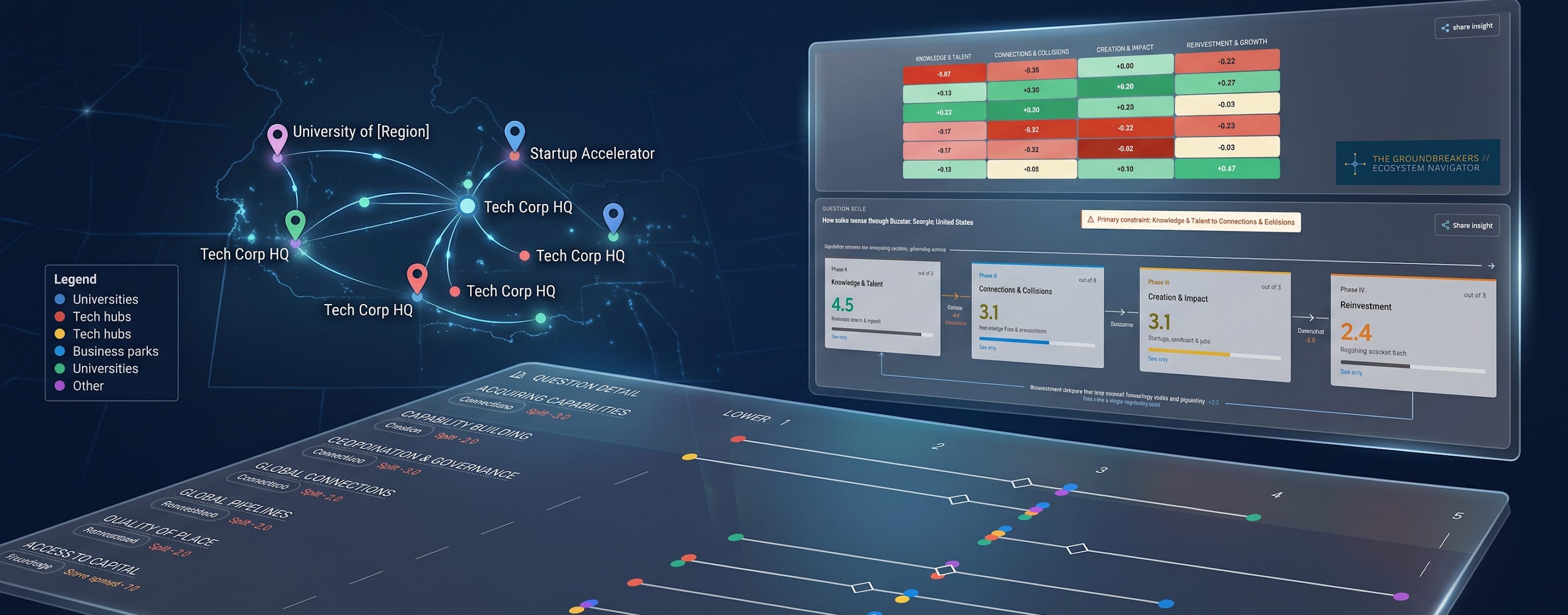
The work of local and regional economic development teams is as challenging today as it has even been, severely complicated by a rapidly transforming macroeconomic landscape. Its forces are at once unavoidable and unpredictable: the imposition of new tariffs of uncertain duration; the emergence of new trade alliances featuring new logistics; the massive acceleration and proliferation of frontier AI and its pervasive effects; and national governments’ responses, from new infrastructure spending to revised tax regimes and program announcements, to new priorities like national security.
In response, regions and municipalities must devise strategies and implement plans capable of delivering sustainable economic growth, while providing resilience against future economic shocks with long-term ramifications. This in addition to managing ongoing economic development operations: business retention and expansion, workforce development, investment attraction, SME and entrepreneurship support, infrastructure development, and stakeholder management.
Strategy Meets Economic Complexity Thinking
Given the relentless pace and the high stakes involved, local economic development strategy needs to be efficient, straightforward, based on real information, and directly address the question of how the region or municipality will achieve its objectives. An excellent, practical model for this work is the Hambrick and Fredrickson Strategy Diamond. It demands focus in five key areas: Arenas (where you will be active), Vehicles (how you will get there), Differentiators (how you will win), Staging (the speed and sequence of your moves), and Economic Logic (how you will obtain returns).
For local economic development, strategy models are useful but insufficient because they aren’t infused with an underlying economic model, one explicitly aimed at growth, innovation, and long-term economic resilience. Harvard’s economic complexity model is an analytical framework demonstrating that a region’s wealth and growth potential are determined not by the volume of what it produces, but by the diversity and uniqueness of the specialized knowledge required to make its products. That diversity and uniqueness is what gives a region or municipality its staying power, its competitiveness, and its case to attract and develop talent, capital, and new specialized knowledge.
With strategy and economic models together, it becomes easier to find the way forward: how can municipalities and regions leverage their talent, capital and specialized knowledge to their long term economic advantage? It’s a straightforward question, yet one that occupies an immense amount of time and resources. Get it right and the result is a virtuous innovation cycle in which knowledge, networks and infrastructure, product development and innovation, and reinvestment work in concert to lift a place into greater prosperity and long-term economic resilience.
There is a local information gap preventing decisive action
All too often, the vital missing element is a quick, structured way to analyze local strengths and identify opportunities identified by experts who know a place best: its local economic development, business, government, academic and entrepreneurial leaders. Without that information both time and accuracy are lost at the precise moment when macroeconomic forces are profoundly, irrevocably changing the game. Losing weeks and months weakens response times, reduces planning accuracy, undermines stakeholder management, and potentially leaves valuable opportunities on the table.
Example: Macro events with local effects
From the Canadian context, here are two competing pieces of information. Both have national consequences; both matter at the local level.
“This should be a five alarm fire for policymakers in Canada. 517 American companies started by Canadians. $414 billion raised. Almost 9 in 10 of them went to school in Canada.” — Lucy Hargreaves. Data from “The Conveyor: How US Capital Recruits Canadian Founders — and What It Produces.”
Productivity Mega Deduction. PM Mark Carney’s Liberal government, under François-Philippe Champagne, Minister of Finance and National Revenue, announced that Canada’s marginal effective tax rate on new business investment will fall from roughly 13% to 6.4%. Businesses can immediately deduct 100% of the cost of eligible new investments – machinery, equipment, and technology — including fibre-optic cable, mining property, oil and gas pipelines, software, research and development, computer equipment, aircraft and vehicles, patents, rail track, bridges, and roads.
Every town and every region needs to respond uniquely
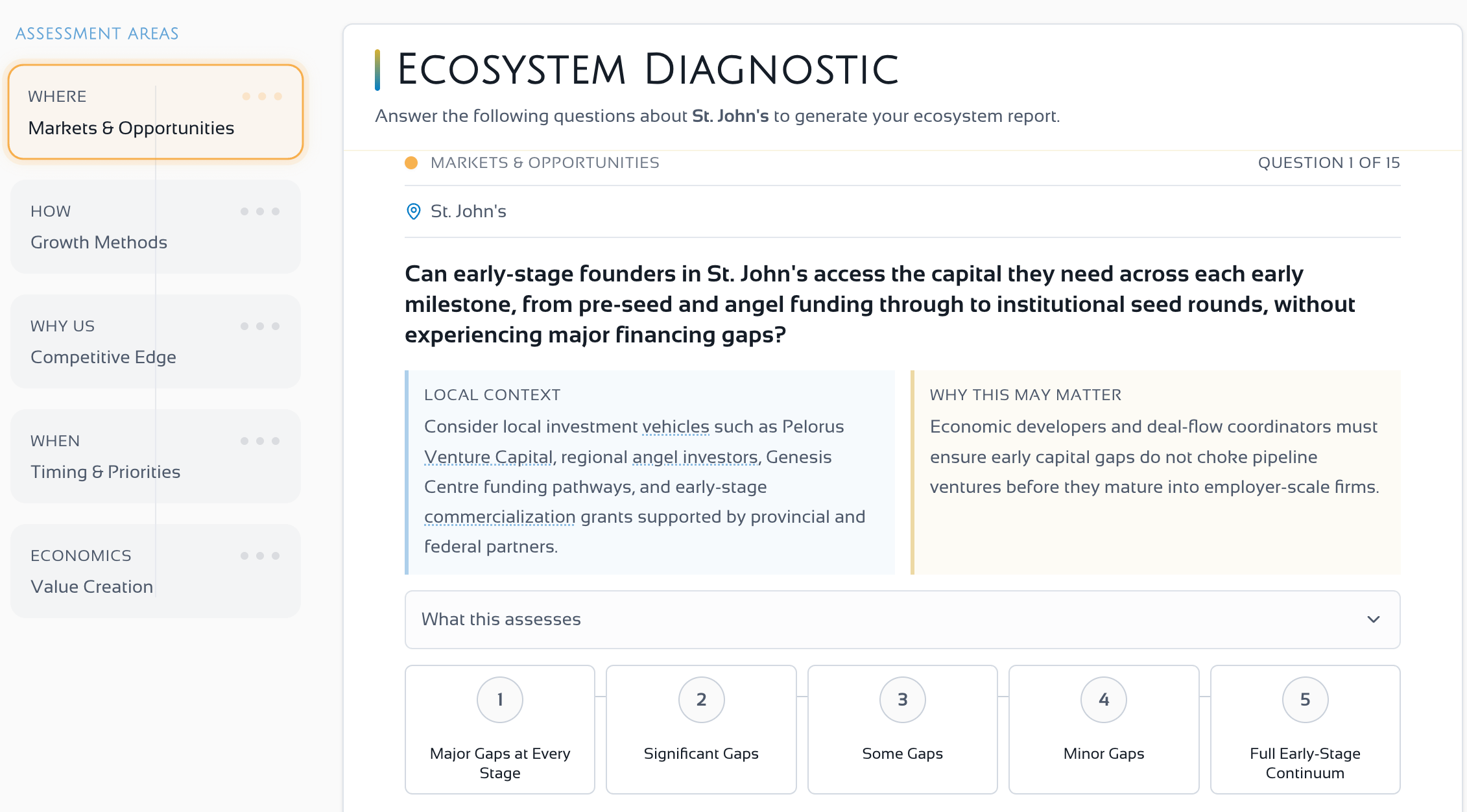
Given the preceding macro context, here are capital availability and infrastructure diagnostic questions asked of four different places, tailored to their local context. Note that the questions are thematically similar but adjust to the local context.
Diagnostic questions produced by The Groundbreakers Ecosystem Navigator.
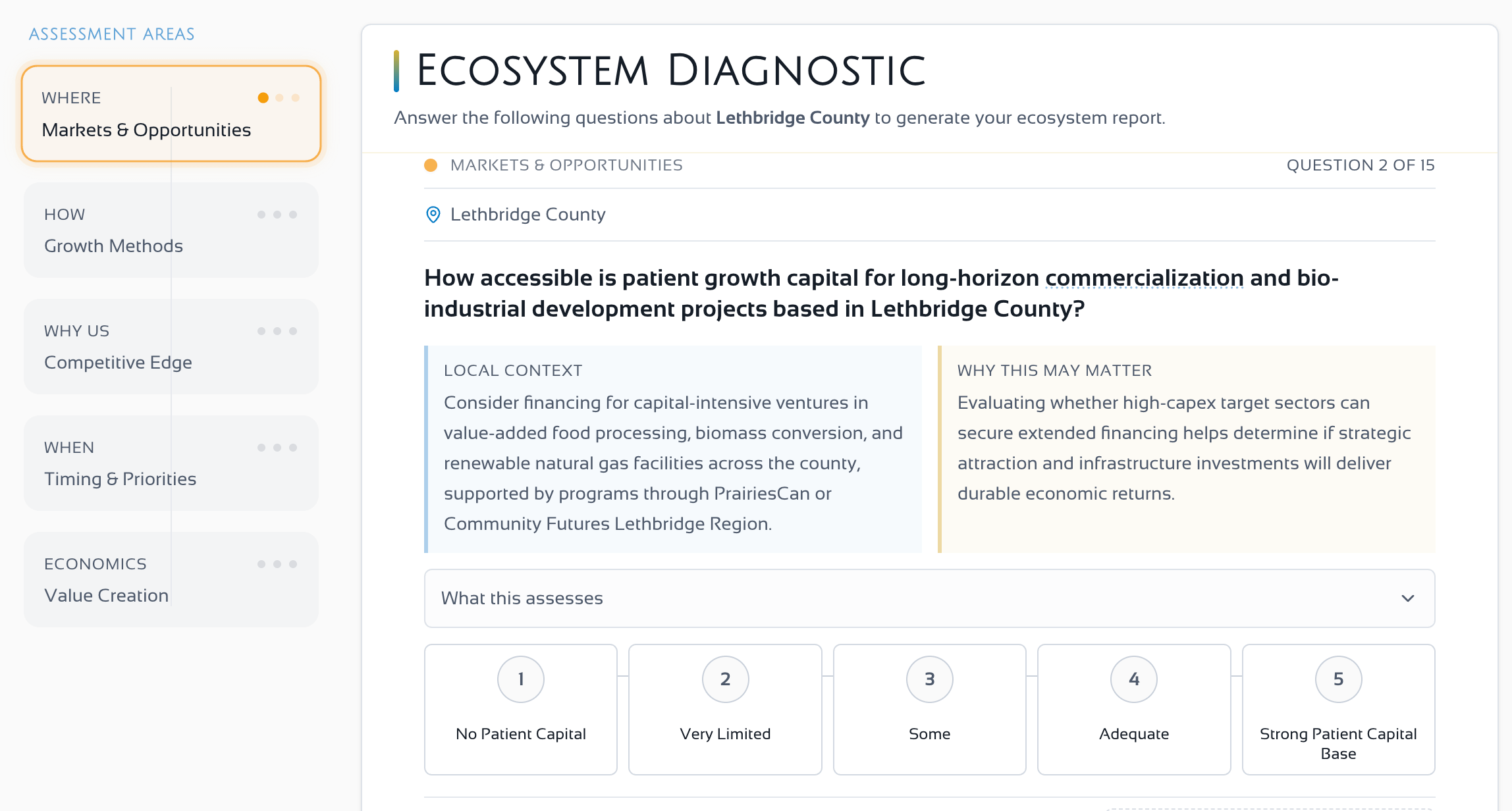
Lethbridge County, AB:
How accessible is patient growth capital for long-horizon commercialization and bio-industrial development projects based in Lethbridge County?
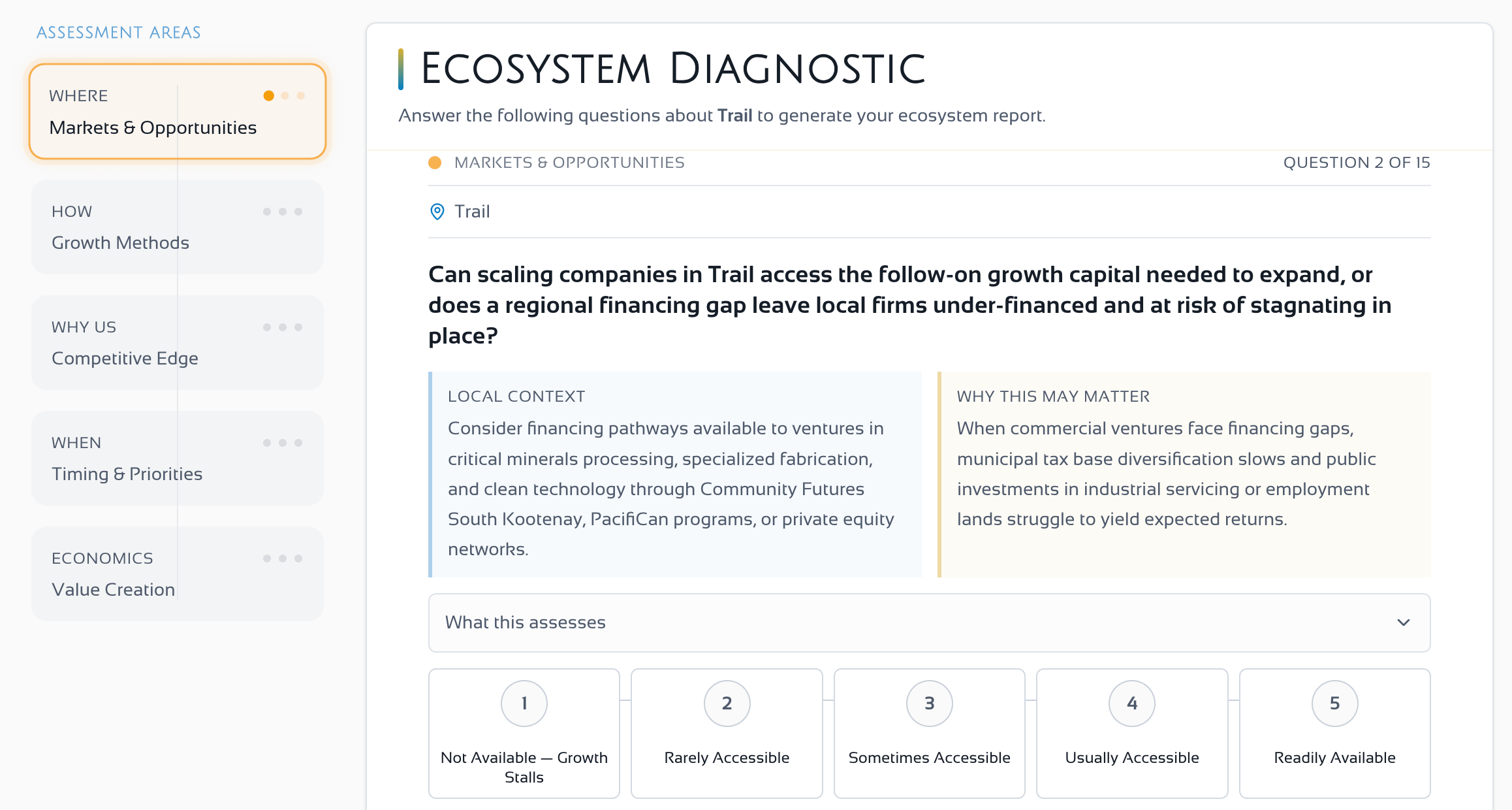
Trail, B.C.
Can scaling companies in Trail access the follow-on growth capital needed to expand, or does a regional financing gap leave local firms under-financed and at risk of stagnating in place?
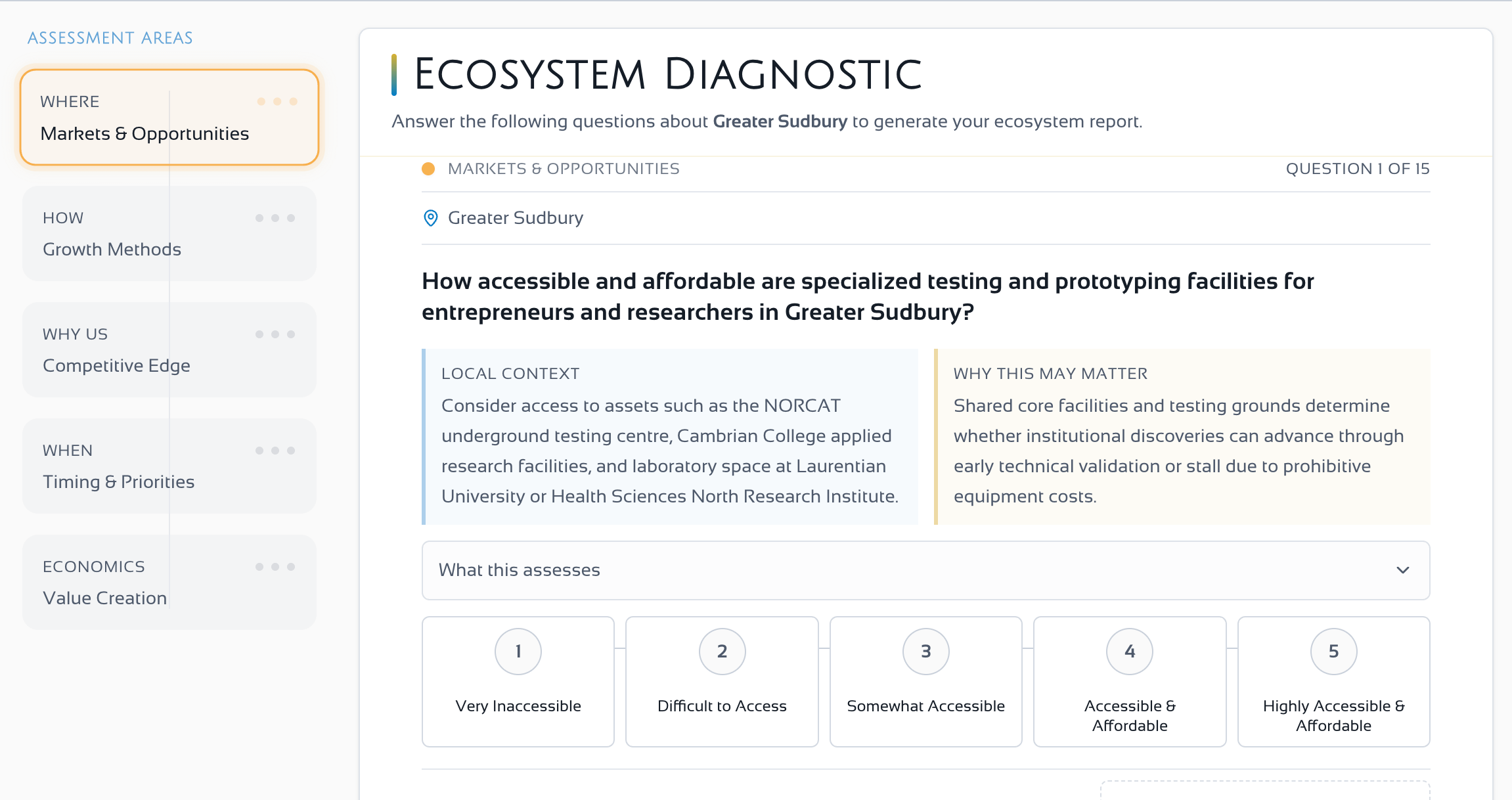
Sudbury, ON
How accessible and affordable are specialized testing and prototyping facilities for entrepreneurs and researchers in Greater Sudbury?
St. John’s, NL
Can early-stage founders in St. John’s access the capital they need across each early milestone, from pre-seed and angel funding through to institutional seed rounds, without experiencing major financing gaps?
Measuring differences across places or groups
This is where asking the same strategy-economic questions of a group of local experts becomes incredibly valuable. The recommendations generated from their structured feedback provides substantial “how and what” direction. Perhaps most valuable of all, the rapidity of their feedback (diagnostics take 10 minutes to complete, aggregated analysis develops in real time as responses come in) is a massive time saver, reducing by months the time it takes to act.
I found the report to be a good way to ground us all, to say, ‘Here are some of the objective things that are necessary to move the ecosystem forward’. It gives us a common language and a common way to talk about it. The report is like a convener, a way of getting everybody on the same page in a discussion document.
— Trevor Lewington, Director, Growth & Engagement, Lethbridge County, Alberta
Build a group diagnostic, easily.
Confronted with rapid economic changes like tariffs, new trade alliances, AI, and national governments’ responses, the imperative is to act quickly and smartly, for which one needs good, current information.
Building a group diagnostic is simple. Each respondent gets the same question, configured to their local context. You send each a unique diagnostic link. As responses come in your evidence base grows in real time.
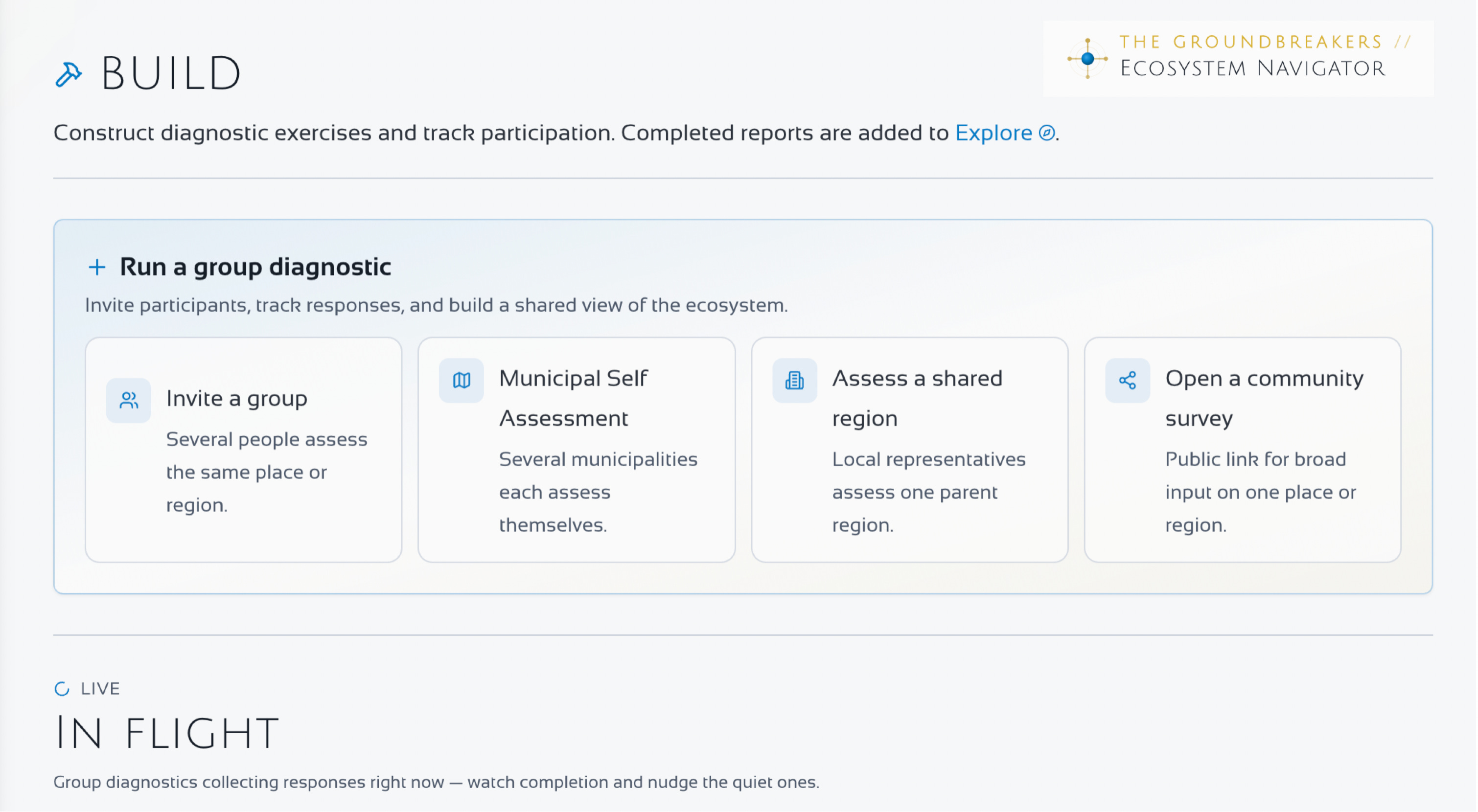
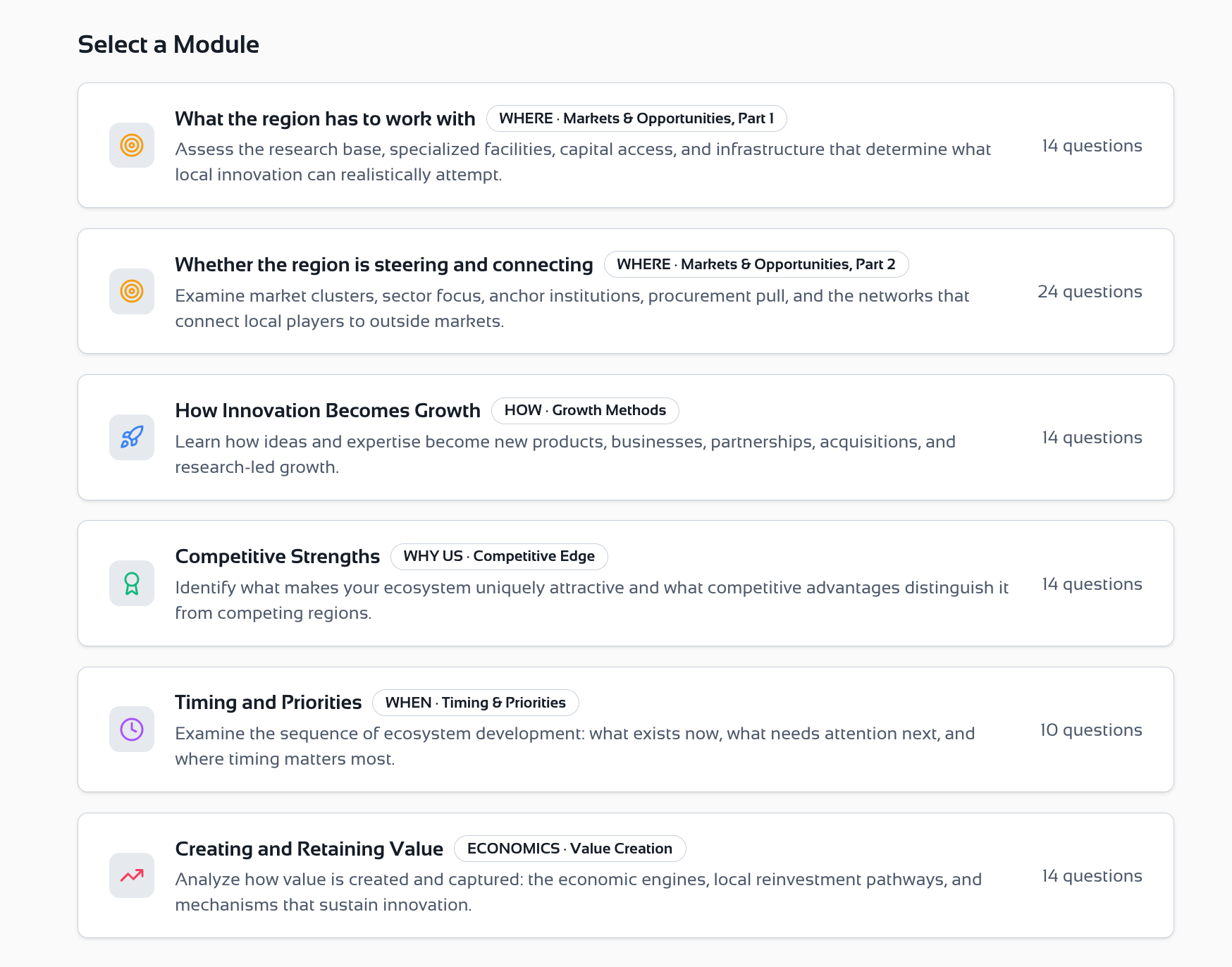
Group diagnostics can pose questions from a cross-section of strategy-economic questions, or can be focused more narrowly into a Deep Dive.
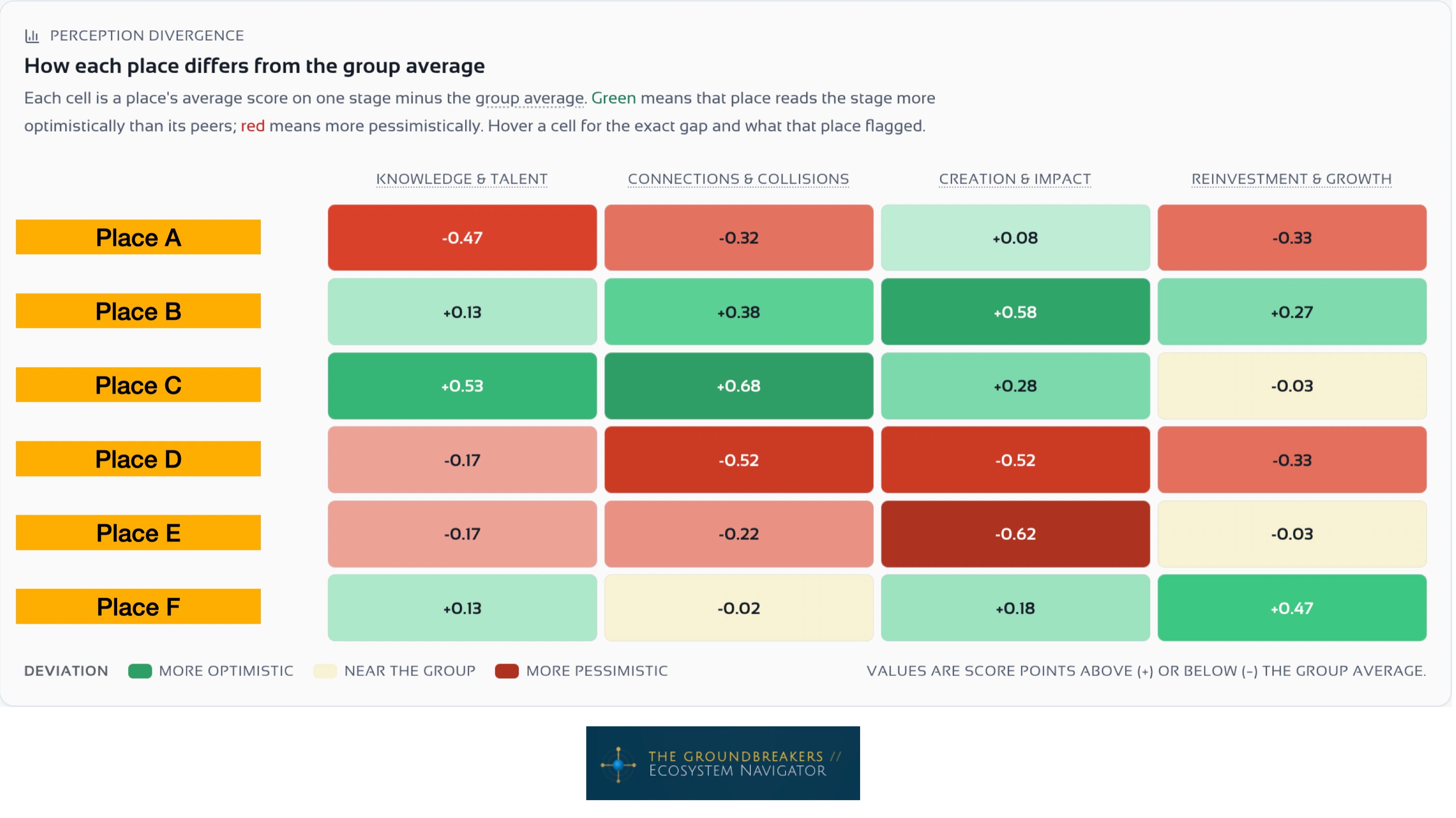
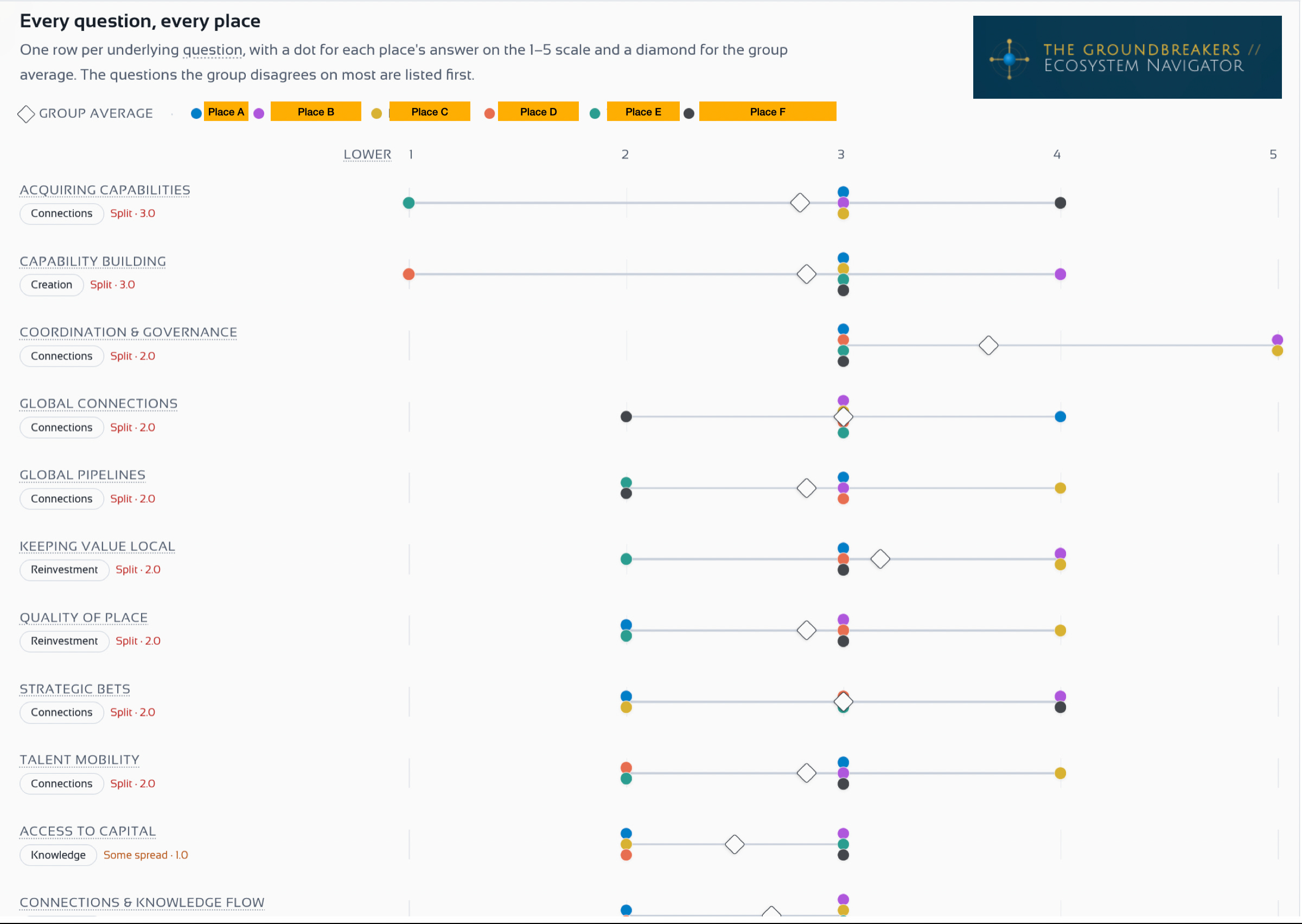
Mapping and understanding differences.
The group’s responses are provided as individual reports and in aggregated form to uncover agreement and divergence. Included are practical recommendations, detailed analysis, and data visualizations.
The platform works. Structured input from economic development professionals across different parts of the county produced clear trends and divergences on growth and innovation. The recommendations were useful and realistic, and the people who answered the questions confirmed the synthesis captured their thinking. — Michael Catsi, President & CEO, Economic Development Board for Tacoma-Pierce County, Washington
Data visualization examples
Optimizing the local flow of talent, capital and knowledge is vital to current and future success. Done right, that flow is a virtuous innovation cycle. Presenting the cycle in diagrammatic form makes identifying gaps and opportunities immediate and obvious.
Speed and accuracy are imperatives, not nice to haves
Economic development work gets truly rewarding when existential challenges like ‘how will our place thrive’ are translated into mission-critical plans, and then operationalized into discrete pieces of work for staff and partners.
There simply isn’t time to waste. If work can be done in 48 hours instead of three months, it needs to happen. Speed and accuracy are imperatives, not nice to haves. That’s because the benefits of AI and geopolitical transformation will not be evenly distributed. It will be won or lost in specific places—in cities, counties and towns where the actual factories, research labs, farms, logistics nodes and skilled people already exist. The places that can rapidly improve the flow of knowledge, talent and capital through their own innovation ecosystems will capture the new work. The places that cannot risk slowly hollowing out.
~
In the Particular Lies the Universal: Knowledge as the DNA of Place

For myself, I always write about Dublin, because if I can get to the heart of Dublin I can get to the heart of all the cities of the world. In the particular is contained the universal.

